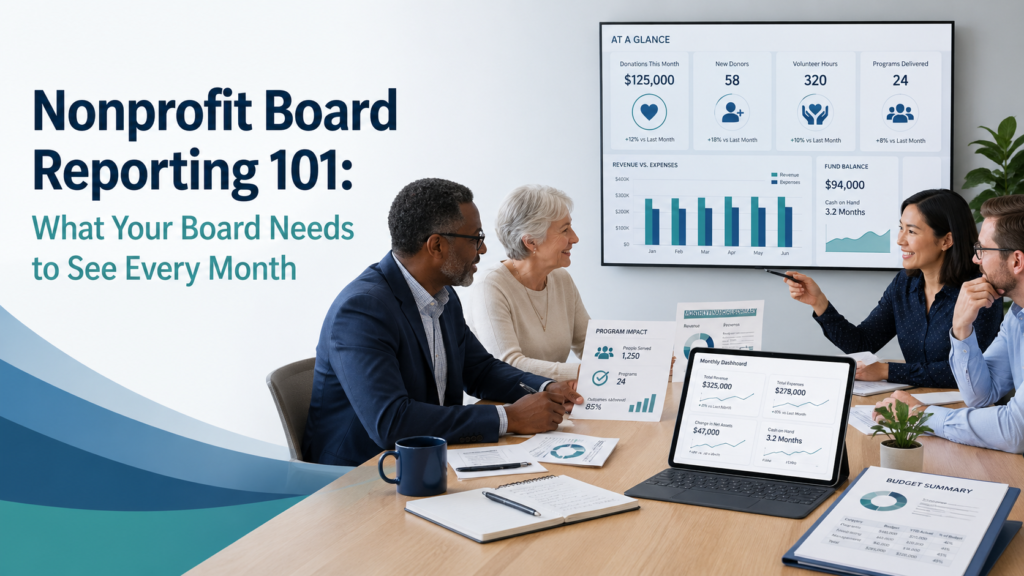
Reading Time: 2 minutesYour nonprofit’s board of directors has a legal and fiduciary responsibility to oversee your organization’s finances. But they can only do that job well if they have clear, accurate, and timely financial information. If your board meetings involve scrambling for reports, explaining confusing numbers, or skipping the financials entirely — that’s a problem worth fixing.
Good board reporting doesn’t have to be complicated. It just has to be consistent. Here’s what your board needs to see every month, and how the right bookkeeping setup makes it easy.
The Core Financial Reports Every Nonprofit Board Needs
Statement of Financial Position (Balance Sheet)
This report shows your nonprofit’s assets, liabilities, and net assets at a point in time. It answers the most basic question your board needs to ask: are we financially stable? A clean balance sheet — reviewed monthly — helps your board spot warning signs early, like declining reserves or growing liabilities, before they become crises.
Statement of Activities (Income Statement)
This report shows your revenue and expenses over a period of time, typically the current month and year-to-date. It tells your board whether you’re on track to meet your budget, where you’re overspending, and which revenue streams are performing as expected. Your board should be able to look at this report and understand it without a finance degree.
Budget vs. Actual Report
Perhaps the most useful report for active governance, this shows how your actual income and expenses compare to your approved budget — line by line, with the variance clearly labeled. When your board can see at a glance that program expenses are 15% over budget or that a major grant came in late, they can ask better questions and make better decisions.
Cash Flow Summary
Even nonprofits with healthy budgets can run into cash flow problems — especially when grant payments are delayed or seasonal revenue fluctuates. A simple one-page cash flow summary tells your board how much cash you have now, what’s expected to come in, and what’s due to go out over the next 30–60 days. This prevents surprises.
Restricted Fund Report
If your nonprofit receives restricted grants or donations, your board needs to see a report showing how much is in each restricted fund, what it can be used for, and how much has been spent. This is one of the most important compliance tools a nonprofit has — and one of the most often overlooked.
Making Board Reporting Easy with the Right Bookkeeping
If producing these reports currently takes you hours — or you’re not producing them at all — the issue usually isn’t willpower. It’s infrastructure. When your bookkeeping is set up correctly, these reports can be generated in minutes, not hours.
At Lighthouse Bookkeeping, we specialize in nonprofit bookkeeping in Nashville, TN and across Middle Tennessee. Our services are designed to make board reporting effortless:
- Monthly close on a consistent schedule so reports are always ready before your board meeting
- Board-ready financial packages formatted clearly for non-financial board members
- Restricted fund tracking built into your chart of accounts from day one
- Budget vs. actual reporting so your board can govern with real data
- Nonprofit plans starting at $89/month — affordable for organizations at every stage
Your board showed up to help your mission succeed. Give them the financial visibility they need to do it well. Explore our nonprofit bookkeeping plans or schedule a free consultation with Lighthouse Bookkeeping today.